Miami Airport Terminals
Miami International Airport (MIA) is one of the busiest airports in the United States and a major gateway between North America, Latin America and Europe. Located just 13 km from downtown Miami, it serves over 50 million passengers annually and offers extensive domestic and international connections.

Passenger Tip: MIA is a key hub for international travel, especially to Latin America and the Caribbean.
History & Origins
MIA was established in 1928 and originally operated as Miami City Airport. During World War II, it served as a military base before transitioning into a major commercial airport. Its strategic location made it a central hub for flights between the U.S. and Latin America, leading to rapid expansion in the late 20th century.
Passenger Tip: American Airlines turned MIA into one of its main hubs, boosting international connectivity.
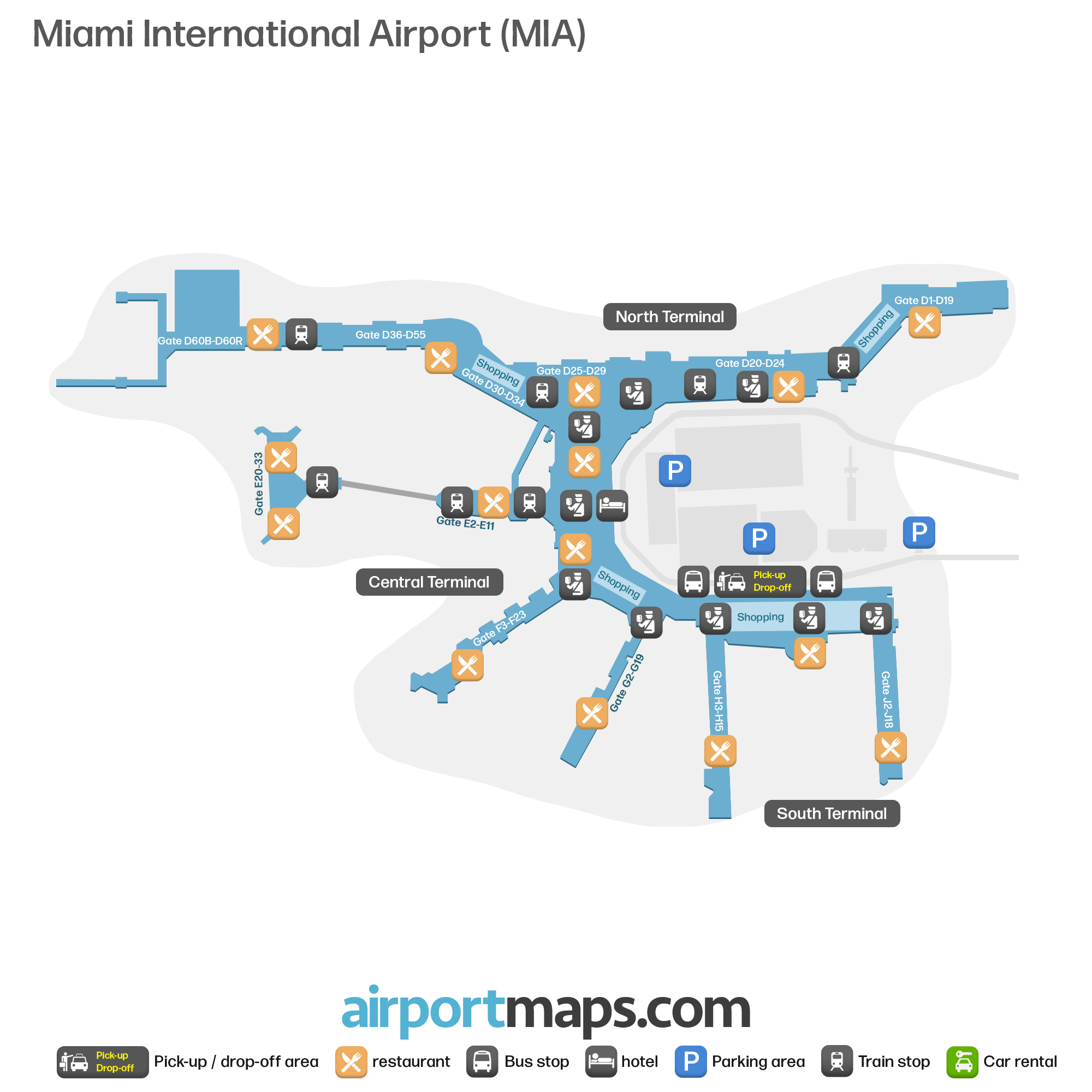
Terminal Overview
North Terminal (Concourse D)
The North Terminal is the largest and mainly used by American Airlines.
- Gates: D1–D60
- Levels: Arrivals, Departures, Gates
- Features: Skytrain system for long distances
Passengers may transfer to their boarding gates in Concourse D by the SkyTrain within 5 minutes.
Passenger Tip: Use the Skytrain to save time when connecting within Concourse D.
Central Terminal (Concourses E, F, G)
Handles a mix of international and domestic airlines.
- Airlines: Multiple international carriers
- Facilities: Lounges, shops, restaurants
Boarding gates: (52 gates)
South Terminal (Concourses H, J)
Primarily used for international flights and modern facilities.
- Highlights: Efficient security, newer infrastructure
- Use: International departures and arrivals
Boarding gates: (28 gates)
- Concourse H: H3-H17.
- Concourse J: J2-J18.
Passenger Tip: South Terminal is usually less crowded than North Terminal.
Facilities & Services
- Free Wi-Fi throughout the airport
- ATMs and currency exchange
- Baggage storage services
- Charging stations at gates
- Duty free, shops and restaurants
Passenger Tip: Bring a portable charger, charging points can be busy during peak hours.
Family & Accessibility Services
- Wheelchair assistance available via airlines
- Accessible restrooms and elevators
- Family restrooms and nursing rooms
- Priority assistance for passengers with reduced mobility (PRM)
Security & Baggage Control
MIA has multiple TSA checkpoints across terminals. Security times vary depending on demand.
- Average wait: 15–30 minutes
- Peak: up to 45 minutes
- TSA PreCheck available
Passenger Tip: Arrive early in the morning or weekends to avoid long queues.
Lost & Found
Lost items inside the airport are handled by the Lost & Found Office. Items lost on aircraft should be reported to the airline.
Check-in & Boarding
- Check-in opens 2–3 hours before departure
- Boarding starts 30–45 minutes before flight
- Self-service kiosks available
Passenger Tip: Online check-in saves time and avoids queues at busy terminals.
Popular Routes from MIA
Estimated Airport Times
Passenger Tip: MIA is large. Allow extra time for walking, especially in Concourse D.
Transfer between terminals
A free MIA Mover connects the airport with Miami Intermodal Center, where the car rental facility and bus terminal has relocated.
The MIC also houses the airport Metrorail station and Tri-Rail terminal.
Location
To get to the MIA Mover, passengers need to take it at the third level, in the central terminal.